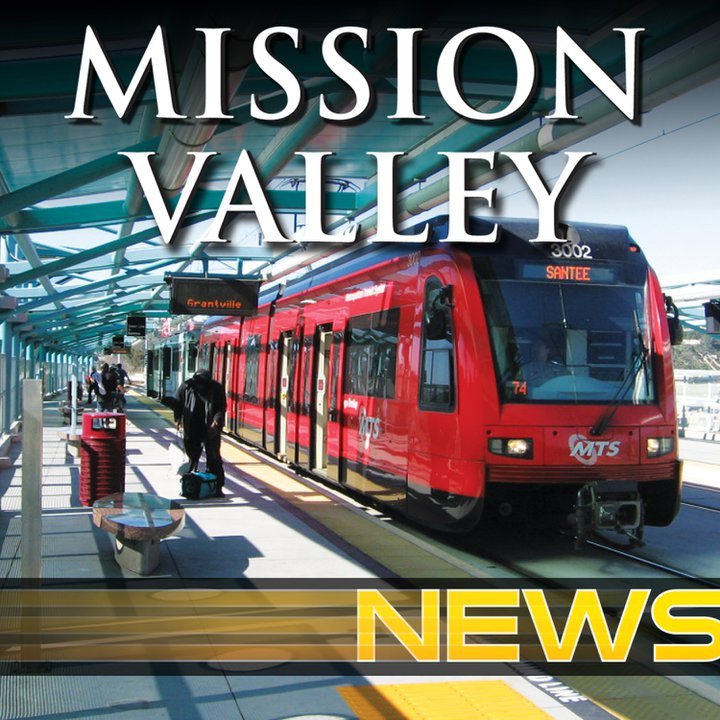
(Mission Valley News, San Diego, CA) – Today, you can hop on a trolley in Mission Valley and take it straight to Santee for some Phil’s BBQ, or to the Gaslamp Quarter for a night out, or to the San Ysidro border crossing for an afternoon of tacos and beer.
In about four years, a newly approved trolley route will connect Mission Valley to points north, including the VA Medical Center, UC San Diego and University City along what is being called mid-coast corridor.
The San Diego Association of Governments, better known as SANDAG, recently finalized its planned route for the mid-coast trolley extension project (the formal name for the plan is the Locally Preferred Alternative).
The new trolley will have stops at Tecolote Road, Clairemont Drive, Balboa Avenue, Nobel Drive, the VA Medical Center, the UCSD campus east of Interstate 5, the UCSD campus west of Interstate 5, Executive Drive and the Westfield UTC shopping mall.
The changes adopted in November will be incorporated into the final environmental impact document, which should be released in mid-2014. SANDAG expects construction to begin in 2015. If all goes according to plan, service on the new route will begin in 2018.
SANDAG’s vision for the Mid-Coast trolley line is less about Mission Valley and more about the lack of regional transit options in the University City area, which has emerged in the past couple decades as San Diego’s “second downtown” due to the high density of jobs and housing in the area.
Congestion and density will continue to rise along the mid-coast corridor over the next 15 to 20. SANDAG estimates that by 2030, the population along the corridor will increase 19 percent, and the number of jobs will increase by 12 percent.
Transportation planners hope that the mid-coast trolley extension will encourage a greater number of people to leave their cars in the garage and take the trolley to work, taking pressure off the already crowded Interstates 5 and 805.
The plan so far has received mixed reviews from the public.
Connecting the University City area with the rest of the trolley system is a long overdue step in the right direction, said Elyse Lowe, executive director of Move San Diego, an alternative transportation advocacy organization.
However, a trolley route that runs parallel to Interstate 5 will limit the potential impact the trolley can have on transit demand in San Diego, Lowe said. That’s because there are not many opportunities for dense growth in the areas around the planned trolley stops. The Clairemont neighborhood, for example, is nearly full with single-family homes already. The same is true for the area around Balboa Avenue, although that is closer to some of the dense housing in Pacific Beach.
“You want to have stops that a huge number of people can walk to,” Lowe said. “Instead we have three stops where the majority of people will be driving, or hopefully biking.”
The new trolley line will also fall short of serving the extremely dense employment center of Sorrento Valley.
Some of the most densely populated neighborhoods in San Diego, including Pacific Beach, Hillcrest and North Park, are not directly served by the trolley.
That’s because transit planners put the trolley roughly where railroad tracks already existed.
The strategy SANDAG has used here is similar to the strategy they used for the trolley’s older routes. They put the trolley where it is cheap and easy to secure the land needed for the tracks, not where a trolley would effectively serve the greatest number of potential riders.
Lowe said she is hopeful that the new leader of the city’s Planning Department, Bill Fulton, will prioritize the development of high-density development near existing and planned transit stops.
On the bright side, the new trolley line will coincide with the development of Civita, Mission Valley’s big new neighborhood north of Friars Road.
Marco Sessa, vice president of Civita developer Sudberry Properties, said the trolley will be a great asset for Civita residents who work in University City.
“The more access we can get throughout the city, the better,” Sessa said. “It’s connecting the next large employment area to Mission Valley.”
The trolley will also serve lower-income people in San Diego’s southern neighborhoods who commute to jobs in the University City area, said Elizabeth Leventhal, a member of the Mission Valley Planning Group.
For more information on the Trolley route extension, visit www.sandag.gov.